


I was thinking today about the rhetoric around the technology that has made an appearance in higher ed over the past twenty years, and if you’re in any field that uses tech platforms, you’ll surely remember a similar path in your own organizations.
Specifically in higher ed, I remember living through the MOOC (massive open online courses) era, the panic that higher education as we knew it was about to experience obsolescence despite the fact that the MOOC structure was at odds with what really matters in learning: The accountability that comes from routine engagement with other humans.
Similarly, I remember sitting through presentations on “Second Life” and thinking, that is never going to be a real thing in a real way. And I remember sitting in an all- hands meeting that was all about how we all needed to go live in the Metaverse and thinking the same thing: That is never going to be a real thing in a real way. It violates everything we know about basic social needs in human life, and I was embarrassed to hear leaders say they wanted to go “all in” on the Metaverse.
Thus, I sat down to list out the technologies inflicted on higher education in the past twenty years and what resulted is an ed-tech graveyard that reveals quite a bit about organizations. I did no research here, so forgive any inaccuracies or omissions (please share what I’ve forgotten!); I’m relying only on my memory and my own notes. Let’s dial it back to 2005, where I’ll share the anxiety of each era as I remember it as well as the tech responses and what the institutional hope each was likely meant to fulfill. Maybe you’ll see some hits you recognize.
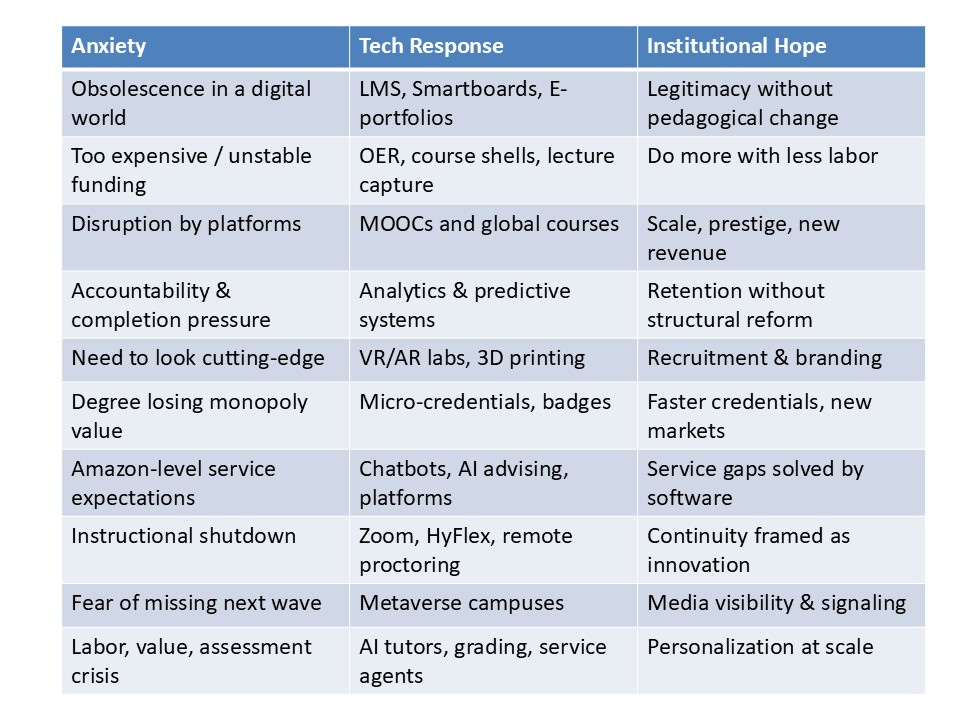
2005–2008: “The internet is here and we look obsolete.”
Orgs felt the pressure to appear modern, digital, and competitive, so the following emerged:
Blackboard/WebCT as the “digital campus”
Smartboards as visible proof of innovation
Learning-object repositories
E-portfolios as lifelong learning infrastructure
iTunes U course distribution
What I see as the institutional hope in this era: Legitimacy in a digital world without changing pedagogy.
2008–2011 (Great Recession era): “We are too expensive and the funding is unstable.”
Early OER as a cost-containment strategy
Publisher turnkey course shells
Lecture capture as a way to “scale” faculty
Clickers as efficiency + measurable engagement
Institutional hope? Do more with less labor.
2012–2014 – The MOOC Moment “Higher ed is about to be disrupted like newspapers.”
MOOCs as full degrees
Udacity credit model
MOOC freshman year
Global star-professor courses
Institutional hope? Scale + prestige + new revenue + lower instructional cost.
Underlying fear? Physical campuses and most faculty become unnecessary.
2013–2016 – The Data Turn: “Accountability, completion rates, performance funding”
Learning analytics dashboards
Predictive retention systems
CRM-style student success platforms
Automated early alerts
Institutional hope: Retention without rebuilding advising, teaching, or financial aid.
2014–2018 – The Immersion/Innovation Lab Era: “We must look cutting-edge to attract students.”
VR classrooms (Oculus wave)
Augmented Reality pilot projects
3D printing as general education
Innovation labs and sandbox classrooms
Institutional hope? Recruitment signaling, donor appeal, branding.
2015–2019 – The Unbundling Threat: “The degree is losing monopoly value.”
Digital badges
Micro-credentials as transcript replacement
Competency-based subscription degrees
Bootcamp partnerships
Blockchain credentials
Institutional hope? New markets and faster credentials without restructuring the institution.
2016–2019 – The “Platformization” of Everything: “Students expect Amazon-level service.”
Chatbots for student services
AI advising (rule-based)
Publisher platforms as full learning environments
Inclusive-access textbook auto-billing
Institutional hope? Solve structural service gaps through software.
2020–2022 – Pandemic Emergency Mythologized as Innovation: “Instruction must continue during institutional shutdown.”
Zoom as the university
HyFlex as permanent model
Remote proctoring as integrity solution
Cloud collaboration as classroom
Institutional hope? Continuity framed as transformation.
Reality: Emergency practices rebranded as strategy.
2021–2023 – The Metaverse Spike: “We missed the last wave; don’t miss this one.”
Meta/Horizon Worlds campuses
“Digital twin” universities
Return of avatar classrooms
Institutional hope? Media visibility + enrollment signaling.
2023–today: Generative AI
We have an anxiety cluster here:
Labor cost
Enrollment decline
Public skepticism about value
Assessment crisis
Productivity pressure
So we get…
AI course assistants
AI tutoring systems
AI grading
AI student-service agents
AI “personalized learning at scale”
Institutional hopes? Do more with fewer people. Restore belief in personalization.
Reassert control via standardized learning outcomes.
The Pattern
I am going to explain the deep pattern across the whole timeline because I see a structural reality beneath all of this: Very few of these were actually about teaching and learning.
They were responses to austerity, enrollment volatility, performance funding, labor costs, prestige competition, loss of public trust. The technology became a coping mechanism for organizational problems situated in our broader cultural and economic policy choices and decisions.
The ed-tech graveyard is not hard to find in the real life. We can walk across almost any campus and see the layers and remnants: You can easily find smart classrooms that aren’t used as designed, a VR lab for touring more than teaching, LMS features we were promised would revolutionize student engagement, etc.
None of these initiatives was foolish (okay, Second Life excluded) and the people who built them were not naïve. Most of the tools still exist in small and perfectly reasonable ways. The pattern I’m talking about shows itself only when you step back far enough to see the sequence. For more than twenty years, higher education has moved from one technological “solution” to another in waves, each one arriving with the promise that it would finally fix cost, access, retention, relevance, or labor. Each one also arrived at a moment of institutional fear.
The graveyard contains tools but it’s really a map of organizational anxiety.
The MOOC moment makes this visible most of all, in my estimation. Publicly, the language was about democratizing knowledge and opening the gates of the university to the world. Internally, the conversation was far more existential. Newspapers had collapsed. The music industry had collapsed. Higher education believed it was next.
MOOCs promised scale, and scale promised survival. What they didn’t do was change the core conditions of teaching and learning because those conditions were never the primary problem they were meant to solve. The same structural dynamic shaped the learning-analytics boom that followed. Dashboards, predictive models, engagement scores. These were framed as tools for helping students, and at times they did help. At the institutional level, they were a response to performance funding, completion metrics, and the growing sense that colleges were being measured to death. Data was supposed to produce control in a system that felt increasingly uncontrollable.
Once you line the waves up against the anxieties that produced them, the pattern looks mechanical to me. Funding becomes unstable, and the sector turns to technologies that promise scale and automation.
Accountability pressures rise, and it turns to technologies that promise measurement and prediction. Enrollment declines, and it turns to spectacle: The innovation lab, the VR classroom, the metaverse campus, because spectacle reassures external audiences that the institution is future-ready.
Students expect Amazon-level service from systems built in the 1970s, and the response is the chatbot. Now, under the combined pressure of labor cost, demographic decline, and public skepticism, the answer is AI and not because AI emerged from a pedagogical need, but because it arrived at exactly the moment the institutional anxiety required it.
The Technology that Actually Matters
From the faculty perspective, I am willing to bet that each wave feels incredibly disconnected from the daily work of teaching and that disconnect is often described by leaders as resistance. More accurately, it’s a structural mismatch.
Most of these technologies were never primarily about improving teaching or learning. They were attempts to solve problems in finance, enrollment management, student services, public relations, and governance. They were organizational coping mechanisms. That’s why the classroom, the place where learning actually happens, often remains the least transformed part of the institution. The work of teaching changes slowly because the tools are not designed to address the conditions under which teaching actually occurs.
This situation is what makes the absence at the center of the story so striking to me from an organizational perspective. The most powerful, proven, scalable technology higher education has for improving student success is not artificial intelligence, predictive analytics, or immersive simulation. It is trust. Trust between faculty and administration. Trust between institutions and students. Trust that allows people to redesign curriculum, take intellectual risks, share governance, and solve problems collaboratively. Trust functions as infrastructure. It produces measurable outcomes, lowers the cost of change, increases adaptability. It makes every other system work better. It’s also the one technology that almost never receives a capital campaign or a task force. Instead, institutions buy platforms.
If this moment is framed only as a question about AI, the pattern will repeat. The sector will ask whether the tool can replace faculty labor, restore personalization at scale, or automate assessment. These are the same questions that were asked of MOOCs, adaptive learning, and analytics. They were the wrong questions then because they addressed the tool rather than the fear that made the tool attractive. The real question is what institutional problem the technology is being asked to manage. Is it the cost of labor, the enrollment cliff, the collapse of public confidence, the brittleness of governance structures? Until that question is answered directly, no platform will solve the problem because the platform is not the problem.
With this lens, the ed-tech graveyard becomes a leadership diagnostic rather than a cautionary tale and allows orgs to ask a different question. Instead of asking what technology should be adopted next, they can ask what problem they are trying to avoid solving in a human way. They can invest in the systems that actually produce adaptation: Shared governance that functions, cross-role problem solving, transparent decision-making, long-term academic planning, real support for teaching. They can treat trust as infrastructure rather than as a by-product of good intentions. That would be a genuine innovation, and it would cost less than the next innovation lab.
AI will not be the last wave. We will see another platform, another environment, another promise of transformation. The open question is whether higher education will continue to use technology as a way to manage its anxieties, or whether it will finally use one of these moments to rebuild the human systems that make institutions work. Not the LMS, not the dashboard, not the bot. The system that determines whether any of those tools can succeed in the first place.
None of this means leaders should become cynical about technology. Quite the opposite. Leaders should be curious. They should experiment. They should pilot new ideas. They should absolutely pay attention to AI because it may well reshape important parts of higher education. The mistake is not trying new things but in confusing novelty with necessity or inevitability.
The next time a technology arrives with promises of transformation, leaders might begin with a different set of questions. What organizational anxiety is this tool actually responding to? What human problem are we hoping it will solve? What evidence suggests this technology changes learning rather than merely changing delivery? Perhaps most importantly, what would have to be true for the skeptics to be right?
Healthy leadership leaves room for those questions because healthy leaders understand that skepticism is not the opposite of innovation but merely one of innovation’s quality-control mechanisms. Orgs need early adopters, but they also need careful observers who ask whether a solution is actually solving the problem it claims to solve. When those voices disappear, organizations lose one of the few mechanisms that prevents expensive mistakes.
The irony is that leaders often ask their organizations to become learning organizations while simultaneously making it unsafe to learn out loud. Learning requires hypotheses, disagreement, failed experiments, and the willingness to revise our thinking when reality refuses to cooperate. If every new technology must be treated as inevitable and every question as resistance, then we have abandoned the very habits of mind we claim to value in higher education.
Perhaps that is the lesson I keep coming back to as I look across this ed-tech graveyard. The technologies themselves are almost beside the point. Some were useful. Most were forgettable. A few genuinely improved aspects of our work. What mattered most, though, was how leaders responded to uncertainty. Did they create conditions where people could think together, challenge assumptions, and test ideas honestly? Or did they demand certainty before certainty was possible?
The next wave is already coming. It always is. We can’t predict it correctly, but maybe we can lead it correctly.


